Task tracking, timesheet, vehicle & equipment management, and reporting for RES construction, maintenance, and O&M operations — web panel and mobile app, offline-first, on a single platform.
Disruptions at wind sites mostly don’t come from a lack of task lists, but from messaging, timesheets, documents, and assignment processes living in different places.
Decision notes, status updates, and field progress scatter across different chats; a week later, it’s unclear what was done and why.
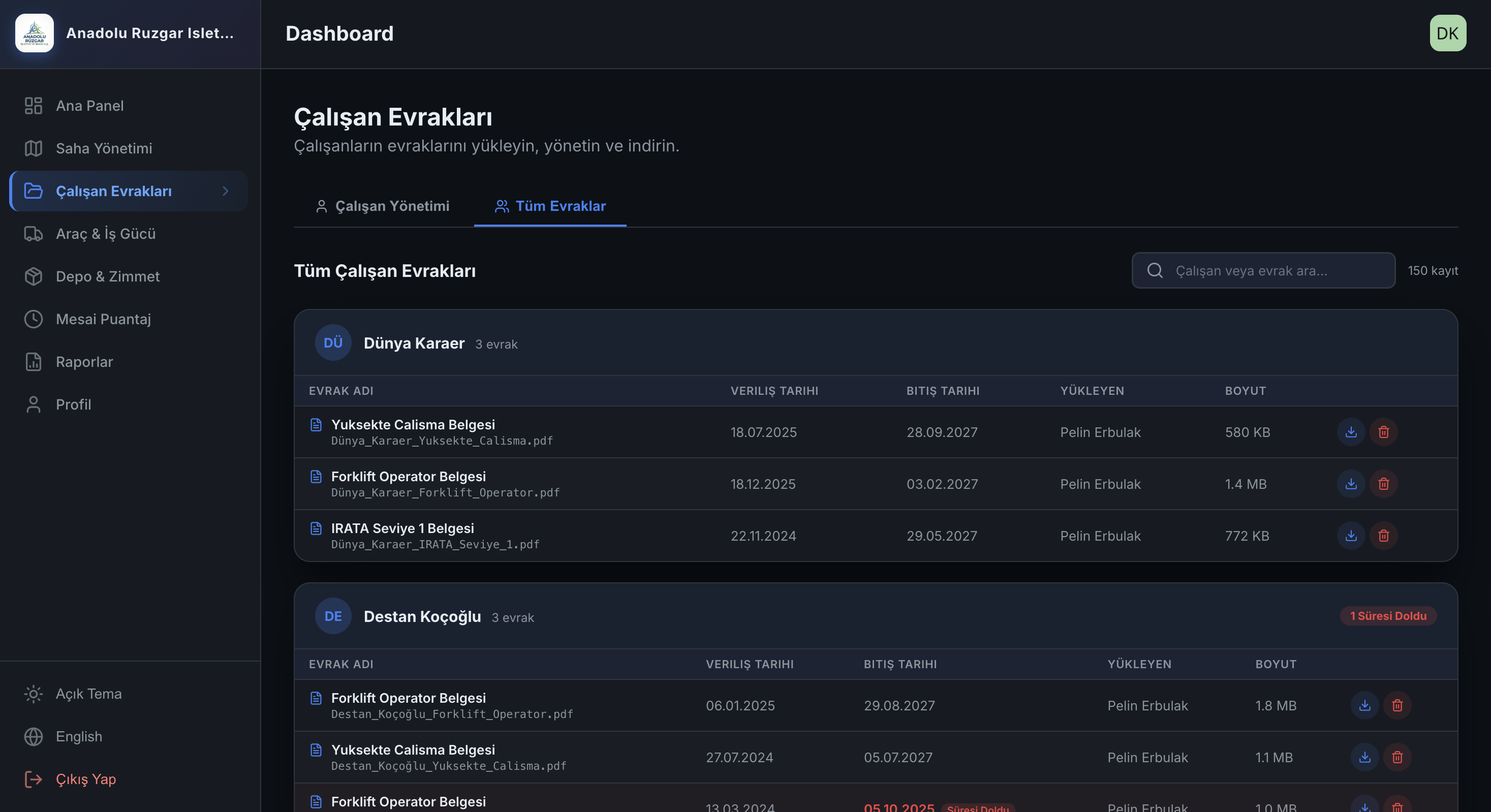
Employee papers, site forms, and compliance documents get lost between folders; expiry dates are caught too late by management.
When overtime, leave, and site entries are collected manually, errors increase; management makes decisions with late and incomplete data.
When it’s unclear who received what and when, with what notes, or when the next service is due, operations silently accumulate risk.
In the field, internet isn’t always strong. If data entry also cuts out when the signal does, the system — not the person — grows the error cost.
Not just a mobile app or just a panel. Management visibility, field execution speed, and retroactive audit trail were designed together within the same product.
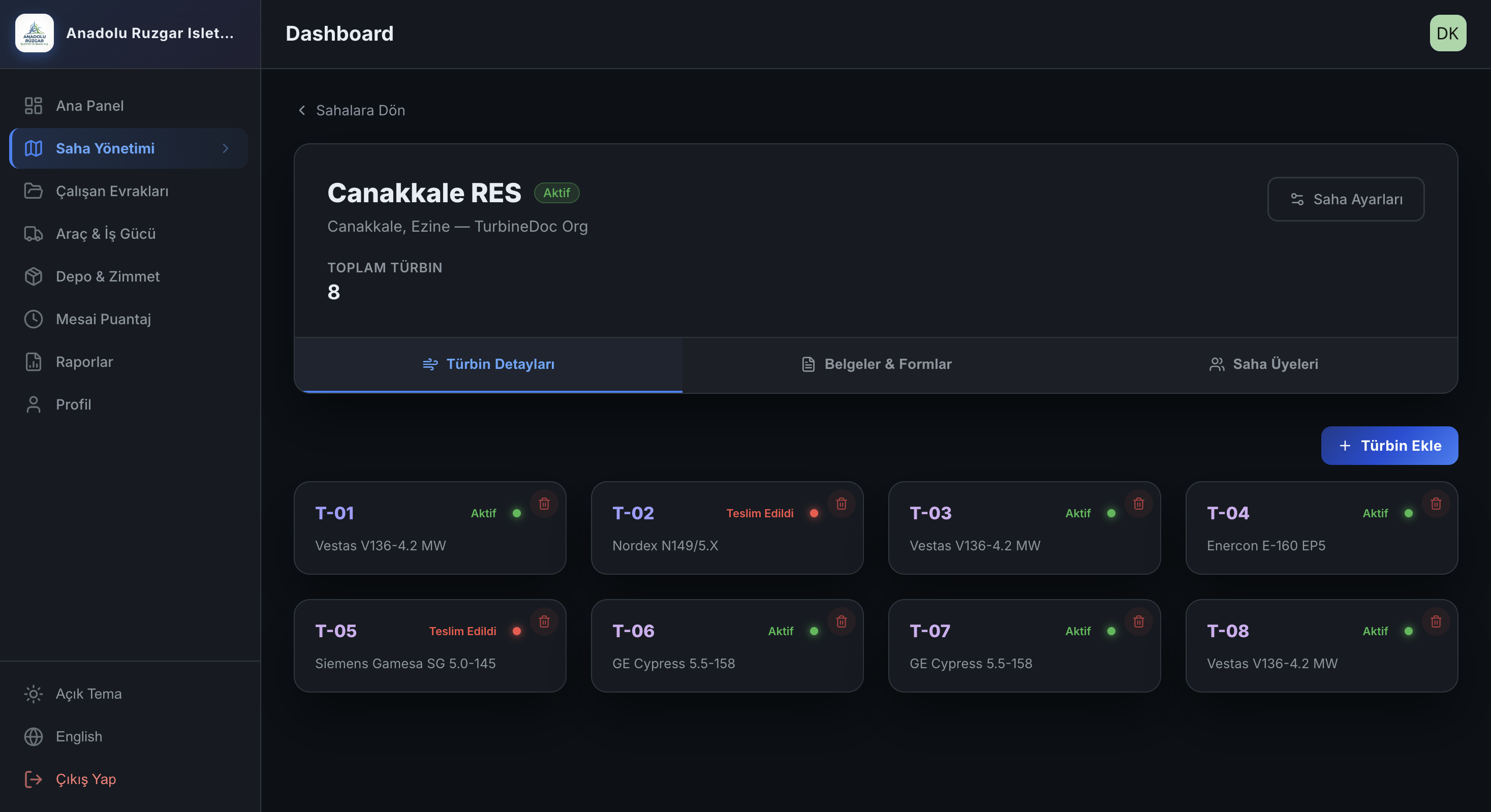
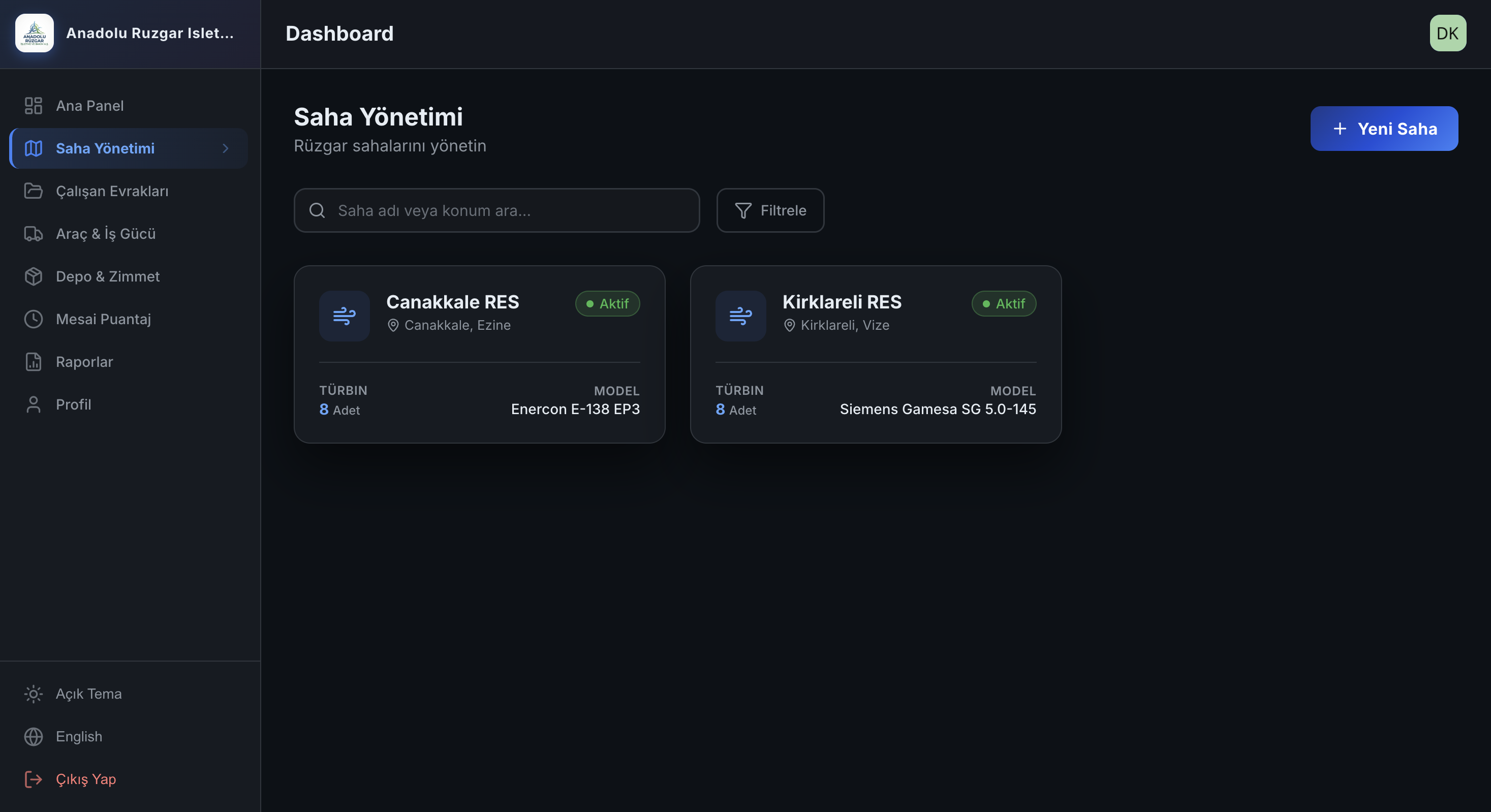
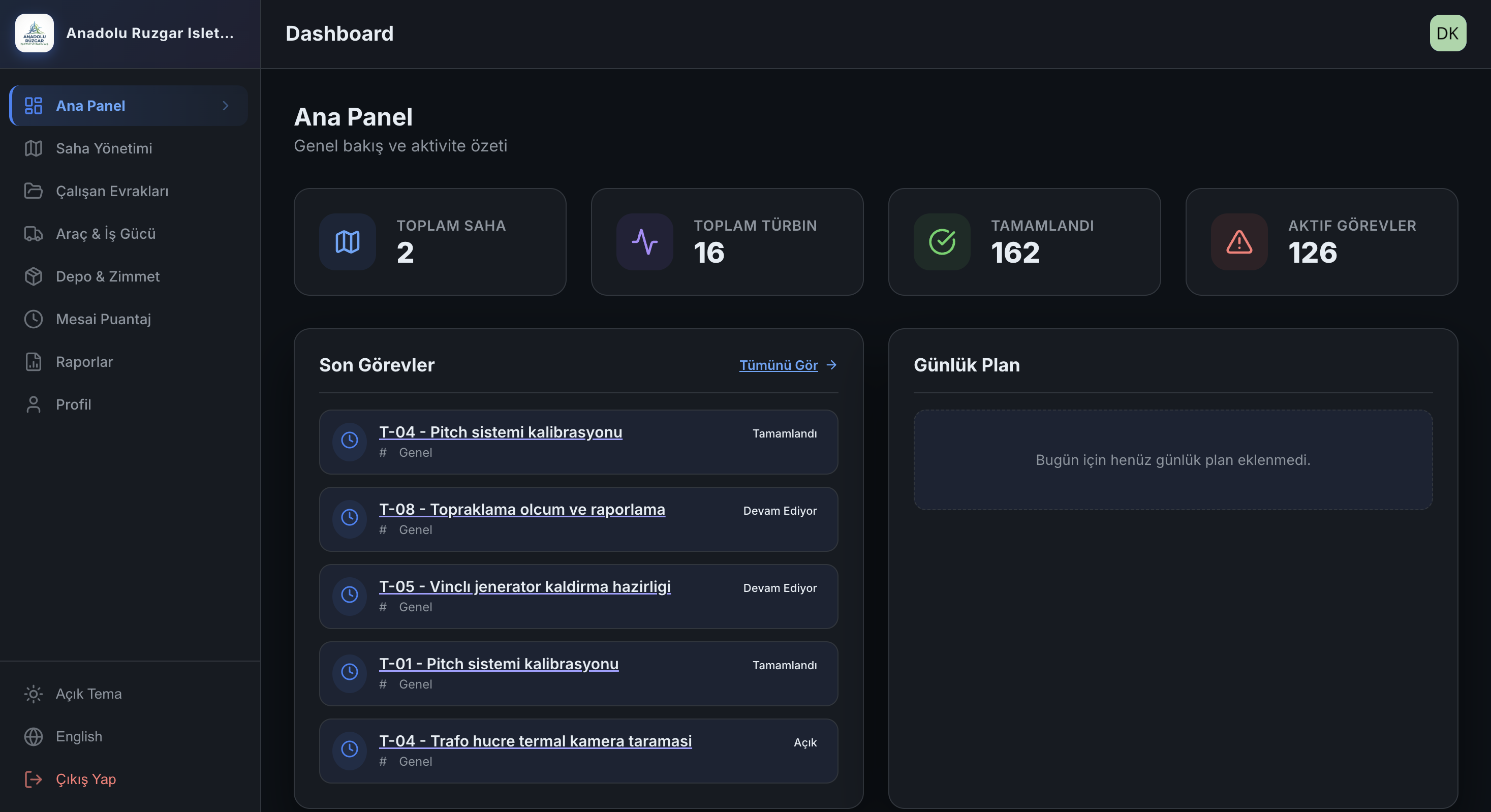
The management panel brings sites, turbines, active tasks, vehicle cards, reports, and employee documents together in one centre.
Field teams run their daily plans, tasks, chats, timesheets, documents, and equipment flows directly from the field.
The trust logic running in the background doesn’t just collect operational data — it makes it defensible in retrospect.
Define sites, turbines, teams, daily plans, and tasks from the centre.
Let field teams enter comments, photos, forms, timesheets, and flow data directly on mobile.
Handover notes, assignments, calibrations, and document dates remain as permanent records.
Gain status visibility from the management panel, generate reports, and conduct retrospective reviews.
Think of each module not as a feature list, but in terms of which risk it closes and whose time it saves.
Sites, turbine counts, daily plans, and active workloads are brought together in one view. An operational map forms for management.
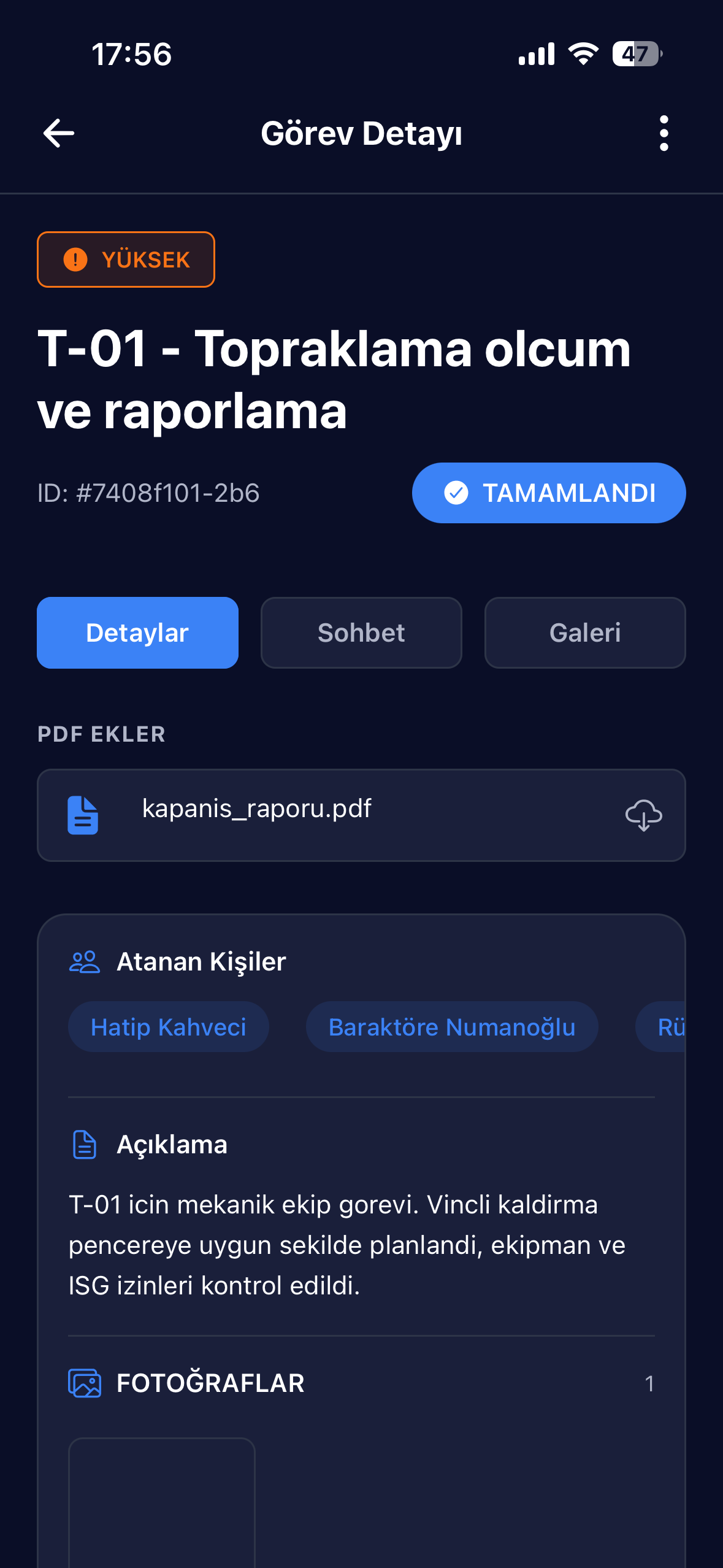
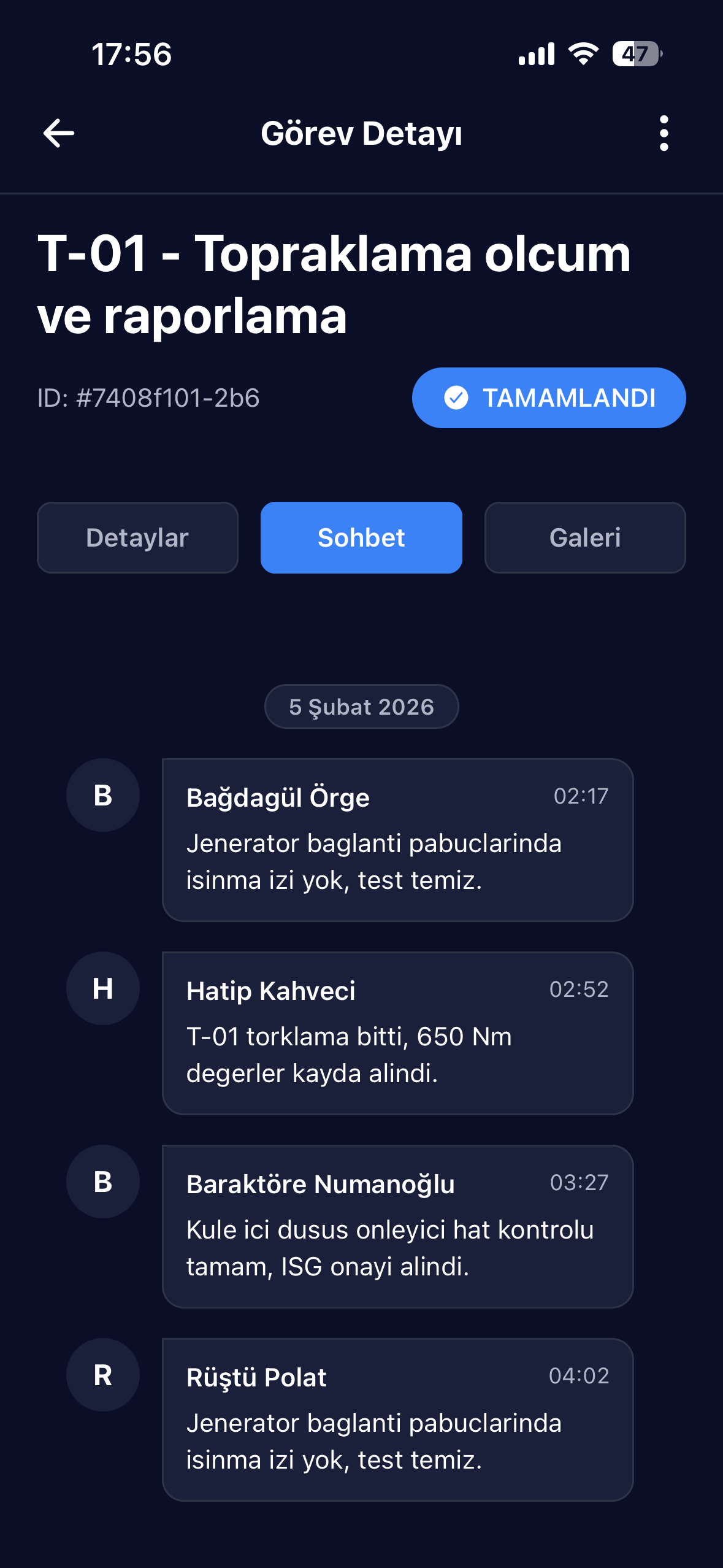
Details, chat, gallery, and closure trail live together inside the task card. Decision notes don’t get lost in phone messages.
Clarifies the turbine-based day flow and active workload distribution. Teams arrive knowing what they’re starting the day with.
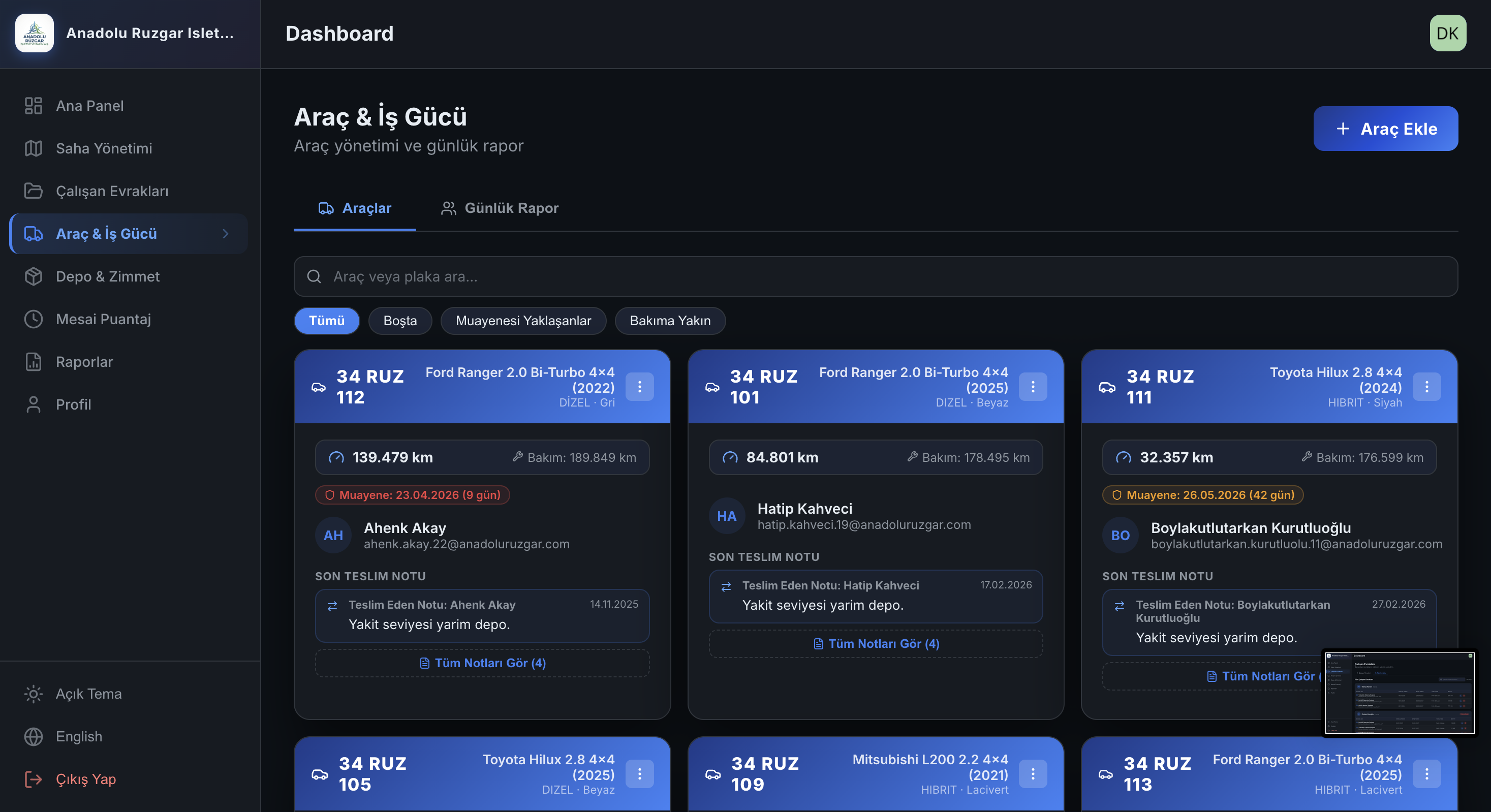
Vehicle cards, mileage, service, inspection, and handover notes all progress in the same module. Operational and administrative tracking stays connected.
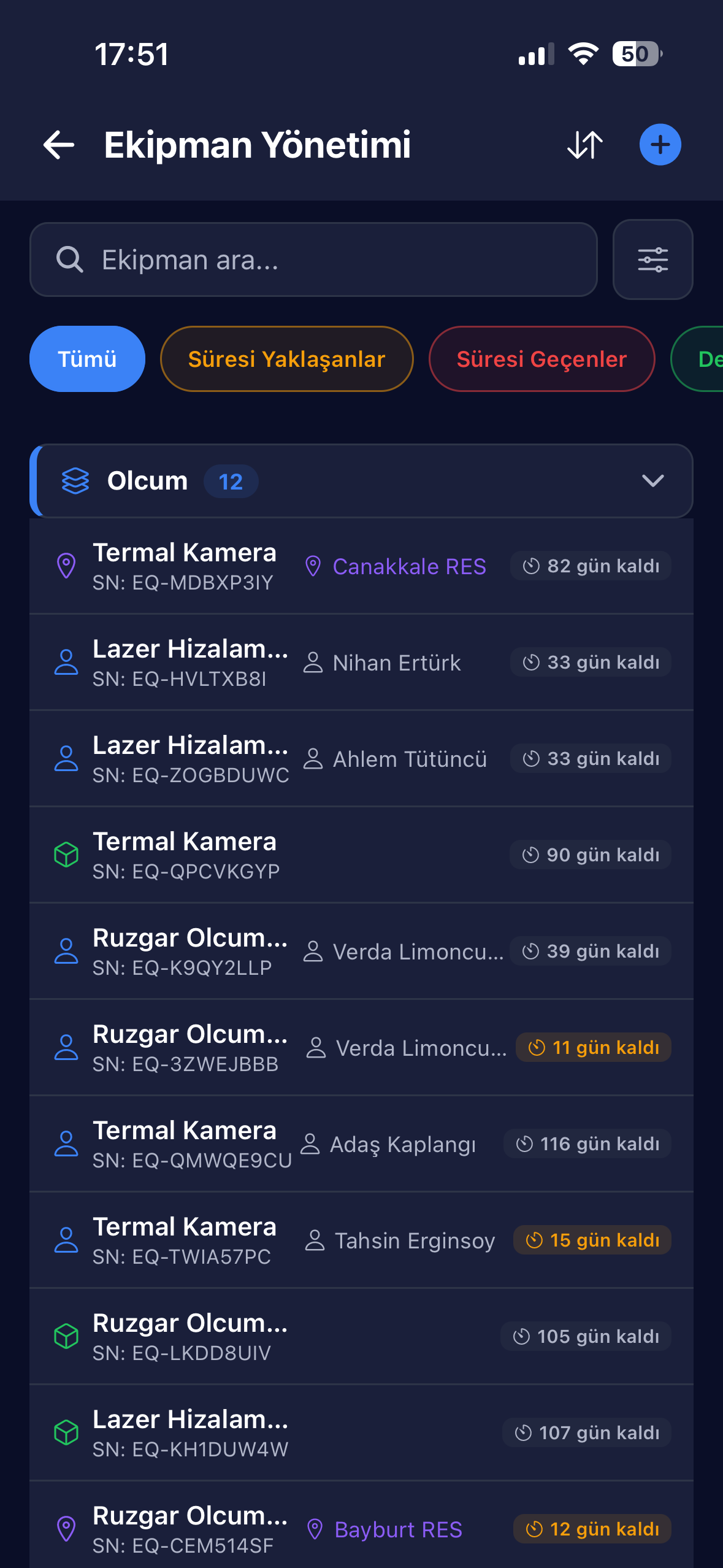
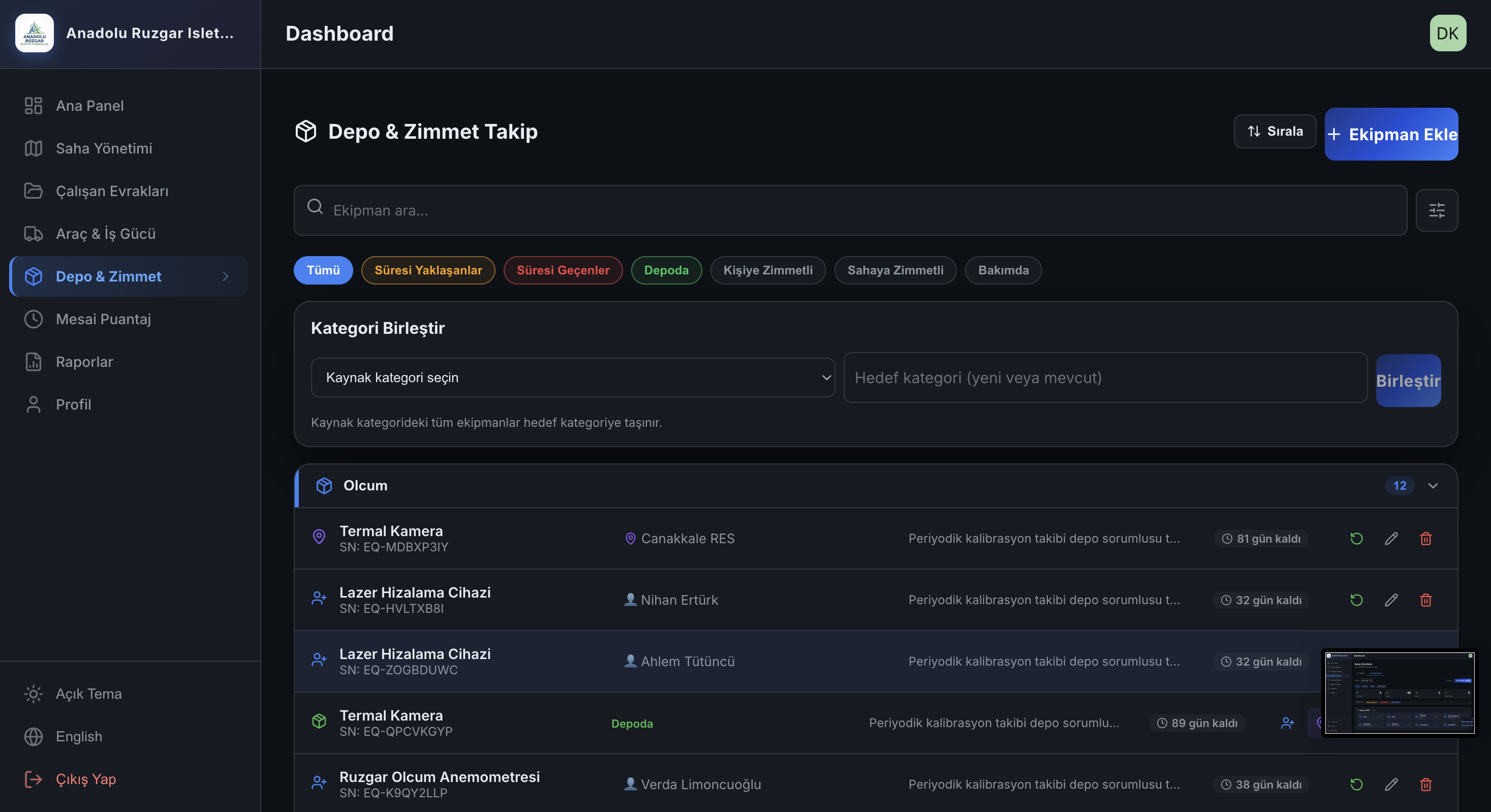
With serial number, assignment status, and calibration countdown, critical equipment is no longer a blind spot. Items approaching expiry become visible early.
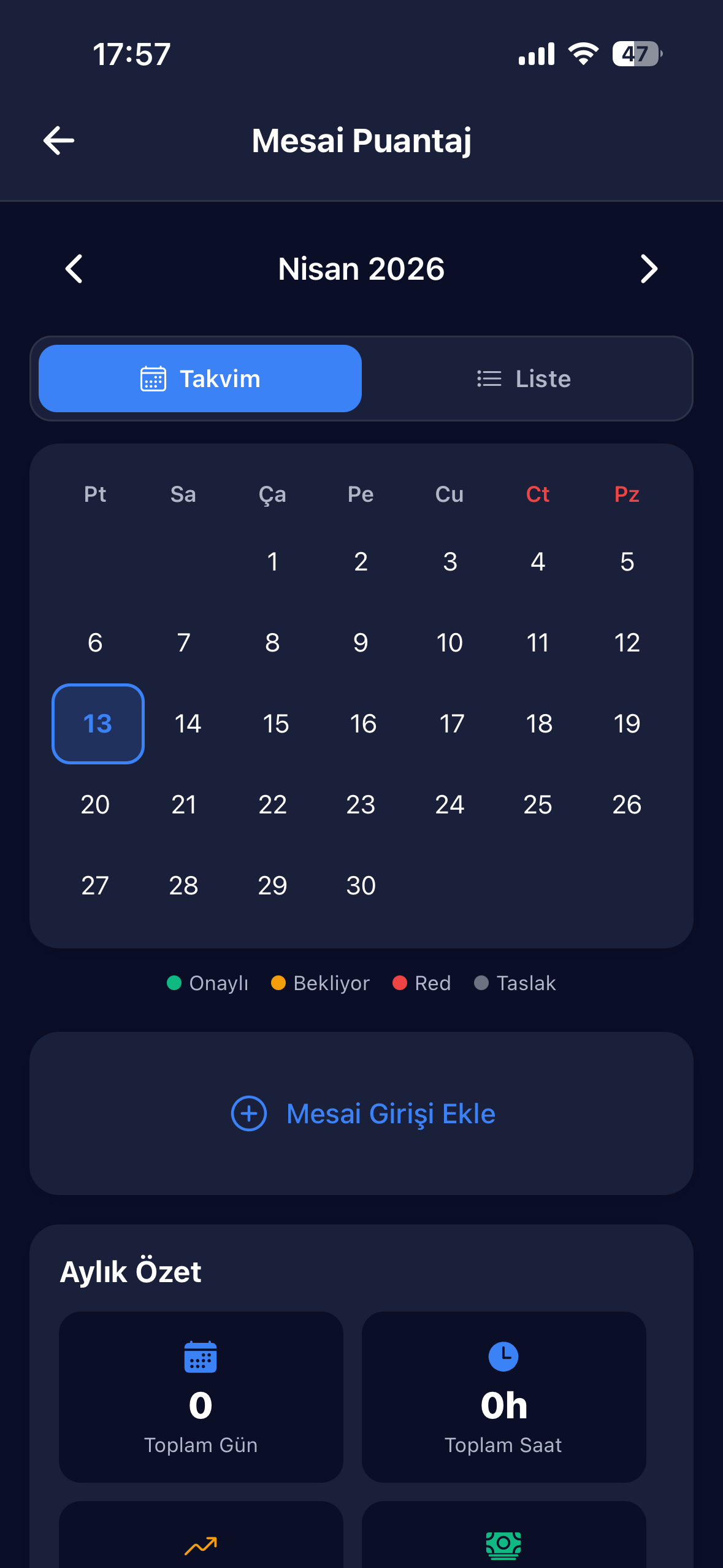
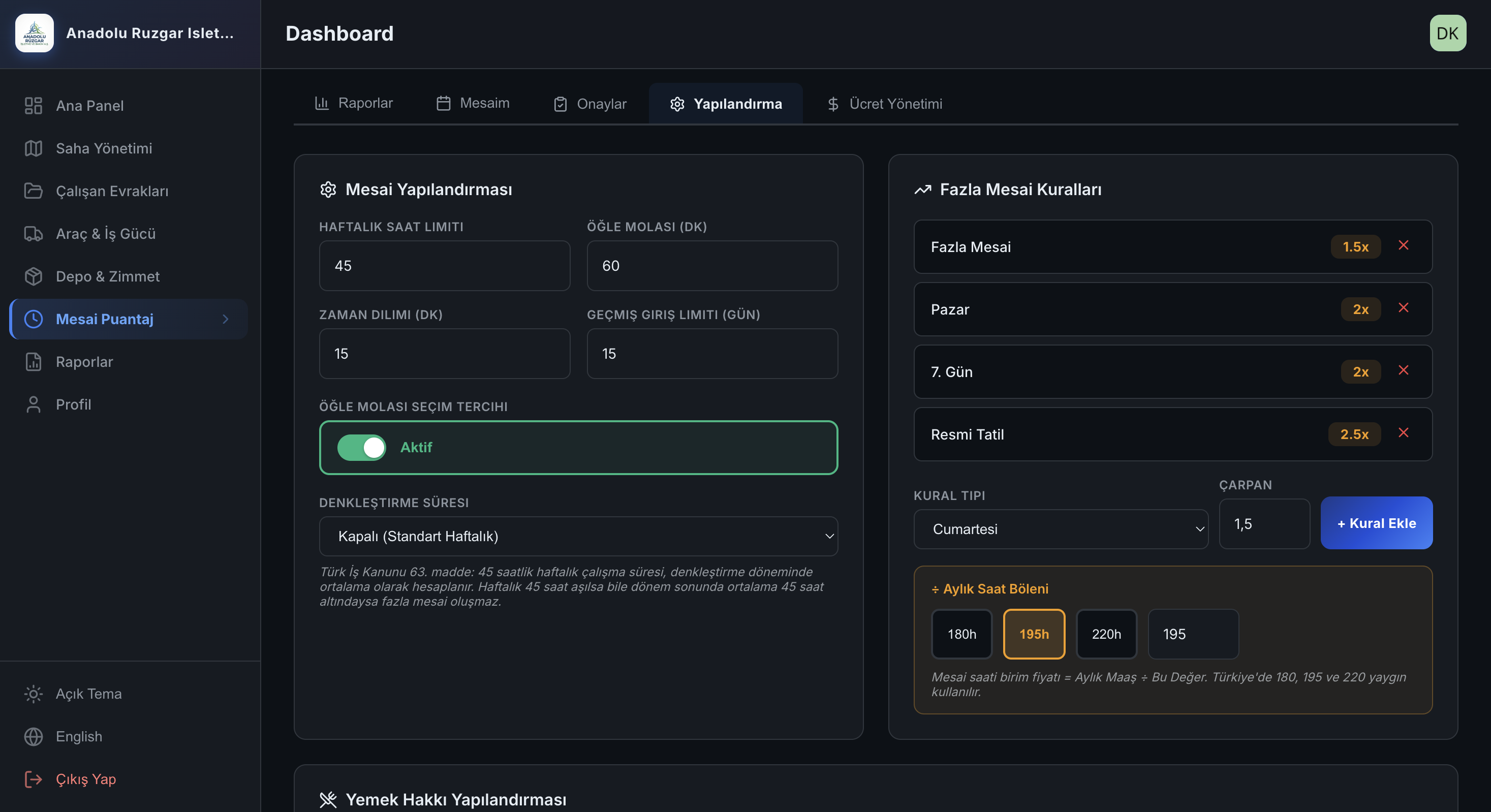
Mobile entry, shift and leave items let timesheets flow from the field to the centre in a standard format. Role-based approval chains speed up decisions.
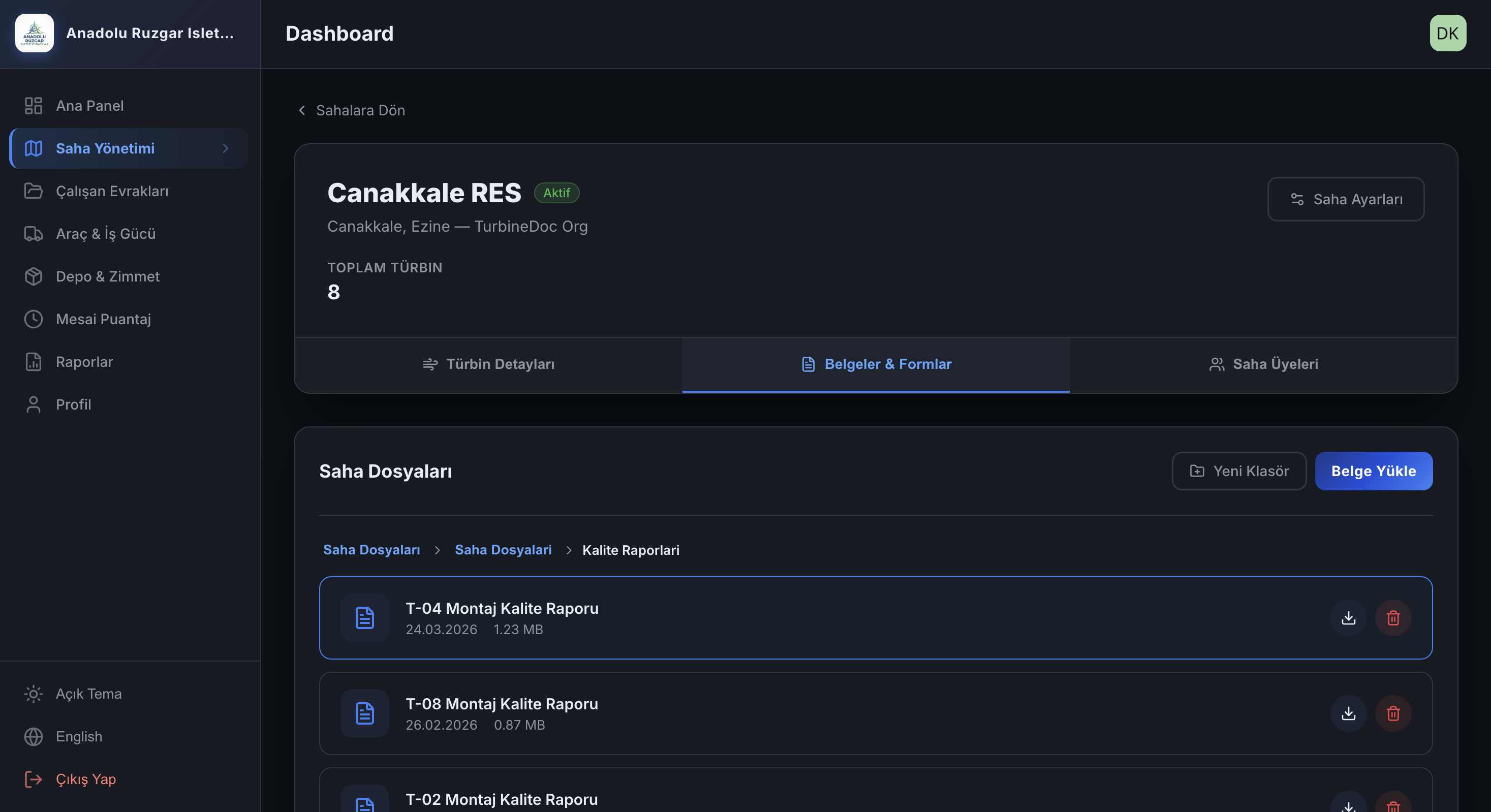
Issue date, expiry, uploader, and file record are tracked in the same table. Expired documents don’t create last-minute surprises.
Instructions, forms, and site documents remain accessible with organised folder logic; teams don’t search in the field.
Operations and backlog reports can be generated for different periods. International compliance through TR, EN, DE, and CN support.
Push notifications and a fast release pipeline let the app reach the field more nimbly. Teams aren’t left uninformed at critical moments.
Role levels, audit records, and encrypted storage for sensitive areas add extra assurance for management and IT.
The mobile app progresses with local record logic; it syncs when the connection returns. Field operations aren’t dependent on signal quality.
The screens below were selected to show that TurbineDoc isn’t just a task tracking tool — it brings the site, people, assets, documents, and reporting loops together in the same product.
With total sites, turbines, completed work, and active task visibility, the decision desk stays always current.
Users reach their own sites, documents, and quick actions from within the app.
Technician, team leader, and management comment on the same task record; critical information doesn’t scatter into messages.
Vehicles are tracked together with operational responsibility, dates, and users.
Measuring instruments and critical equipment become visible with approaching-expiry logic; the field has no surprises.
Document name, issue and expiry date, and uploader are visible in one table.
Instead of collecting data at day’s end, timesheet records are entered into the system the moment they’re created in the field.
Management establishes a common standard in the timesheet flow; the varying Excel logic for each site disappears.
Because stock, assignment, and handover flows live on the same platform, equipment responsibility is clarified.
Forms, site documents, and operational materials become organised for the centre and accessible for the field.
📋 Task & Site Management
Task creation, assignment, chat, and closure trail — mobile and web work in sync.
⏱️ Timesheet, Documents & Compliance
Field work records, approval flow, employee certificates, and expiry dates are consolidated in one system.
🌐 Web Portal
A comprehensive web portal that lets you manage the field from the office. All data is synchronised in real time.
The manager sees — from a single panel — how many turbines are at each site, who is actively working, which tasks remain open, and which documents are approaching risk. The field team uses the mobile counterpart of the same flow; no separate table, no separate folder, no separate message chain is needed.
This approach doesn’t just create order. On audit day, at the point of handover, and in end-of-day reporting, it gives operations a defensible memory.
Many products talk about task tracking. What accelerates a customer’s decision are the second layers that actually touch the real difficulties in the field.
The mobile app progresses with local record logic; it syncs when the connection returns, and conflicts become manageable.
Approaching calibration, inspection, and document expiry dates are visible via separate filters; risk doesn’t wait until the last day.
Vehicle transfers are recorded with mileage, notes, and inspection data; assignment disputes leave less room for interpretation.
Site manager, project manager, HSE, team leader, and technician work in the same system with different permissions and responsibilities.
Controlled storage logic for sensitive fields — especially salary data — makes operational data more reliably manageable.
TR, EN, DE, and CN support, alongside push notifications and OTA update capabilities, makes field deployments more flexible.
Correct positioning wins by showing not what the software does, but which friction it removes on the customer’s side.
What’s happening at which site today, who is actively working, and what is delayed — all visible from one panel.
Documents, assignments, and historical movements aren’t searched; they’re filtered and shown.
Even in low-connectivity areas, record flow doesn’t break, so the workday doesn’t need to be rewritten.
Because date, person, and note-based history forms on the vehicle, equipment, and task side, responsibility boundaries become clear.
TurbineDoc offers a stronger proposition not as a general task management tool for broad use, but for structures that know the field reality of wind energy operations.
If your goal isn’t just digitisation, but making field, people, assignments, documents, and reporting processes manageable — the next step is matching the demo flow to your own site structure.
Start free, scale as you grow.
Free
$0 / month
Starter for small teams.
Pro
$499 / month
$299 / month40% Off
Full capacity for large operations.
Access TurbineDoc for free on iOS and Android devices. Account setup takes just minutes.